We’ve covered tree width and tree shape – now on to the third part of the saddle fitting trine: panel configuration. It’s probably the least known and understood facet of saddle fitting, yet it is just as crucial to fitting a horse as the correct tree width and shape.
To begin with, let’s look at the rear of the panels. You can break them down into two distinct types. There are gusseted panels:

And there are plain panels:

Gusseted panels are almost always flocked (either with wool or synthetic wool), while the majority (though by no means all) of plain panels are foam. Often, a plain panel is better for a more angled, “roof” back:

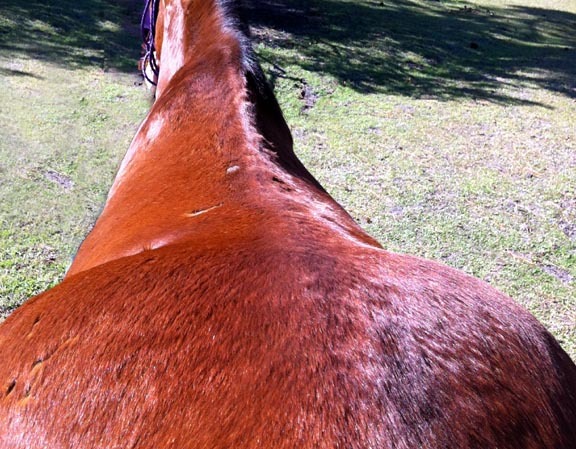
while a gusseted panel usually suits a broader, laterally flatter back:


Putting a plain panel like the one shown above on a flat-backed horse will limit the weight-bearing surface to the outer edge of the panel, while putting a roof-backed horse into a flatter, gusseted panel will limit the weight bearing surface to the inside of the panel, close to the channel. Either will make a horse very sore in a fairly short time.
The rear gusset can be modified to suit an individual horse’s conformation; if a horse has a big wither, a deeper rear gusset can be added to lift the cantle of the saddle and make it sit level:

A shallower rear gusset is often helpful to balance the saddle on a longitudinally flat back or on a croup-high horse; it can keep the cantle from sitting too high:
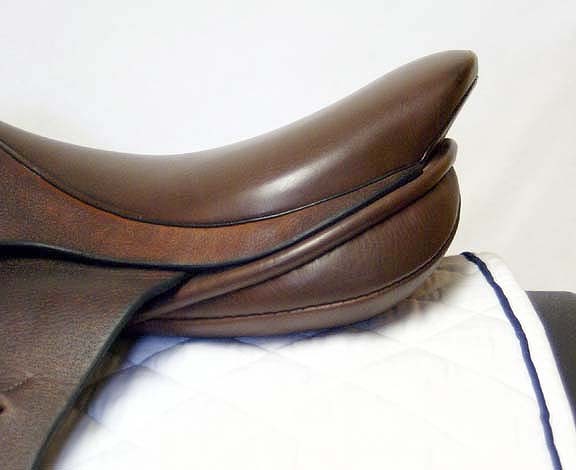
Another common fitting modification to the rear is an upswept panel. Instead of extending past the cantle, the panel is shortened and “swept up”. This is often used for croup-high horses, or for short-backed horses whose riders require a larger seat size; it can keep the weight bearing surface of the saddle from extending past T18:

The front of the panels can also be modified, adding gussets to address fitting issues. One modification with a couple of different applications is the full front gusset:
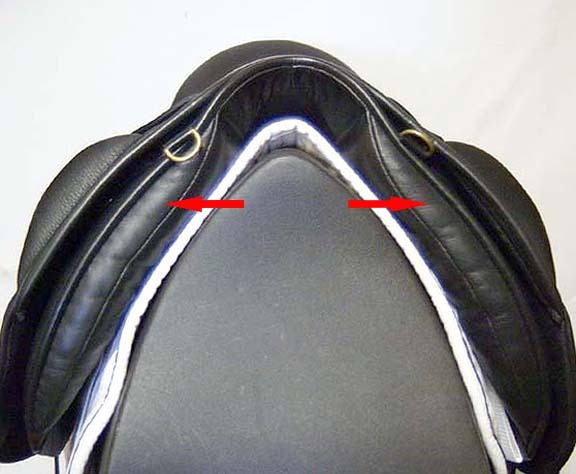
This can be used on a horse with a tall, “steeple” wither to help support the front of the saddle so it clears the wither. It can also be used on a rounder, croup-high horse as a “stop” to help keep the saddle from sliding forward onto the shoulder.
Another “front of the panel” modification is a wither gusset:
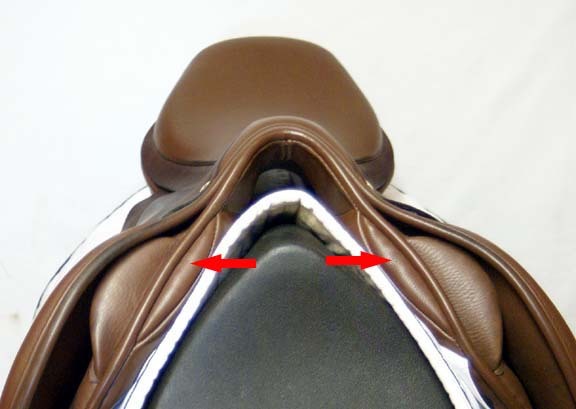
Instead of extending down the entire front of the panel, the wither gusset is designed to fit into the hollows below the wither and “fill in the dips”:
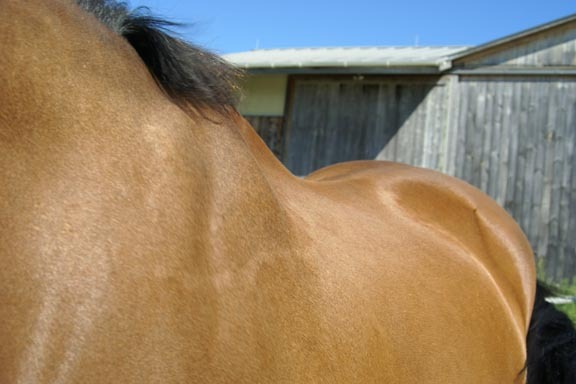
As with the full front gusset, it helps support the front of the saddle to insure wither clearance, and it provides more panel contact and weight bearing surface for a horse with “keyhole” withers.
Finally, the underside of the panel can be modified. These modifications tend to be geared toward the leaner, withery horses and should be used instead of simply using a narrower tree to clear a big wither; they increase the bearing surface of the panel along the wither to help keep the saddle from nose-diving. These two particular modifications are often used in conjunction with either a wither gusset or a full front gusset.
Before we look at the modifications, let’s just see a standard configuration so we get a good idea of just how much the modifications change the shape of the panel:

The first modification is called a dropped or trapezius panel:

This panel is a good choice for a horse with “dips” below and behind the wither; the “bubble” indicated by the arrow helps to fill in that dip and support the front of the saddle. This horse is a good candidate for a trapezius/dropped panel:

The second modification is a K panel. Here it is on a dressage saddle:

And here it is on a jump saddle:

Instead of having a “bubble” like the trapezius or dropped panel, this is deeper throughout the front third of the panel, making it a good choice for a horse with a tall, steeple wither.

So there you have it: the three “big” factors of saddle fitting. Tree width, tree shape, and panel configuration. Of course, there’s also billet placement … but that’s an article for a future newsletter!
One Response to “More Than Width, Part III: Panel Configuration”
Bonnie Cox
This is literally the best series of articles on saddle fit I’ve ever read. I never fully understood that the panels were so adaptable. I’m shopping for a roof backed horse right now, and finally understand why my go-to saddle model isn’t working for my new guy.