Asymmetry is defined as a lack of equality or equivalence between parts or aspects of something; lack of symmetry. We see it in people, horses, saddles, and so on. How does asymmetry affect us and what can we do about it?
First of all, the saddle must be even and symmetrical. Are both sides evenly flocked, the tree straight and the panels sewn on straight. Generally, a new saddle will be symmetrical, but there are instances when a flap may be sewn on more forward or a used saddle may come to us with one side being flocked more than the other so it is important to check this or have someone check the saddle. You can draw an imaginary grid down the center and across to help visualize the evenness or lack thereof.
Asymmetry in horses, sometimes, can make saddle fit a bit of a challenge. There can be slight differences in the sides of your horse, but sometimes they are quite remarkable! Some examples include shoulders in which one side is more forward or higher than the other. More common is that one side is more developed than the other side. There can also be varying degrees of height differences in the pelvic region.
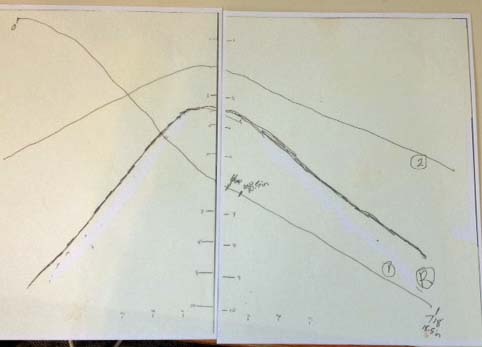
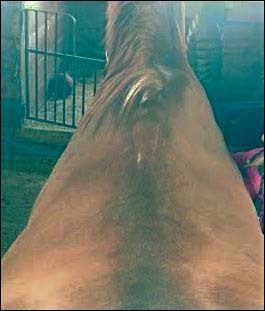
When the horse has differences between the sides of the body, it can greatly affect saddle fit. If not addressed, the saddle may shift down on one side, twist from side to side or be pushed forward or backward. In turn, the rider will find it difficult to find balance and evenness in riding.
There are several solutions to this saddle fit issue. Aside from different strategies to get one’s horse more symmetrical, the immediate goal would be to get the saddle balanced on the horse. It is hard to develop the horse properly if the saddle does not fit. Some fitters advocate flocking asymmetrically. Many more fitters don’t like that solution for multiple reasons. It is harder to make the saddle even down the road and in the event that you might want to sell your saddle, it would need to have the flocking adjusted evenly. Another reason would be that if your intent is for your horse to develop the hollow or shallower sides, then an unevenly flocked saddle may inhibit development.
When shimming, you might need to experiment. I have discussed this in previous articles but generally, shim the hollow side and sometimes you will also need to shim the opposite rear side to keep the saddle from twisting. Play with the amount or depth of shims and placement, knowing that you can adjust as development occurs.
Riders are often uneven as well, having a stronger and weaker side. Many of you have probably had your instructor tell you to sit on both seat bones. Always leaning, collapsing or sitting more on one side or the other can cause the saddle to squish down more in the flocking, requiring more flocking adjustments. If not addressed, it can cause unevenness in the horse.Mounting from ground can cause issues with the symmetry of the saddle as well.
Riders can be uneven laterally or longitudinally, tending to sit more forward or backward.. In my ski teaching days, I used to play with balance issues by having the skier lean fore and aft and/or laterally, more on one side and then the other until they could find a neutral position. That is an exercise that is also useful to do on a horse to find your neutral spot. If the saddle is not in balance however, it will be challenging to find neutral balance.
A rider may actually have conformational issues due to an accident, surgery or other reasons and then those issues must be addressed. In many sports, the issue might be addressed from the ground up such as canting the shoe or boot. That involves a wedge on the inside, outside of the foot or heel of the shoe to create an equally balanced stance. In that case, it still remains important to keep the person anatomically aligned so as not to create other muscular issues. On a horse, one might need to “cant” the saddle. In extreme cases, a saddle might have a little bit more foam added to one side but in general, it would be more beneficial to create some type of lift, very slight to even out the pelvis. The slightest adjustments can make a big difference. Playing with pads under the saddle could mess with the saddle symmetry and fit on your horse, so that would not be recommended. Ideally, you should feel even pressure on both seat bones with your legs under you as if someone had lifted you by a string attached to the top of your head, gently lowering you onto the saddle. Even if you have a jump saddle, you should not feel as though your pelvis is tipped too far forward, nor should you feel you are in a chair seat. There have been many posts on COTH that address those questions and most often, it can be a function or poor saddle fit; too small of a seat, stirrup placement or the wrong twist. In any case, it is something that should be considered.
Riding should be harmonious. There are enough challenges in the quest to be a better and successful rider. Asymmetry in either horse or rider shouldn’t hamper one’s efforts by creating more challenges so if you are a rider faced with these issue, make sure to work with someone to help you figure out how to solve the problem.