With our understanding of the anatomy and physiology of the horse, as well as, the mechanics of our equipment, panel options are evolving and improving more and more. Solutions are becoming available to find the perfect fitting saddle for every horse, even the ones right off the rack. However, all of these options and choices do not make it any easier to pick exactly which saddle will be the best fit for you and your horse. The following is meant to define these “options” specifically, and explain how they deviate from the standard.
Saddle panels are one part of the saddle that can have multiple options. Being the weight bearing surface of the saddle, it is very important to get the correctly shaped panel that provides the most continuous contact between the horse and the saddle. This enables the saddle to disperse the weight or pressure per square inch of the rider. To the left is a picture of the standard panel shape. This standard panel works well on horses that have good, filled-out toplines, without any dips or hollows behind and to the side of the wither, or without a prominent, bony wither. The width and angle of the panels may vary making it suitable for various conformations but it is still a standard type panel.

Another type of panel is the drop or trapezius panel. This panel is primarily meant for horses that have a dip or a conformational hollow just behind and to the sides of the wither or perhaps for a horse with a large shoulder and slight dip. The extra depth and shape that this panel has fills up the localized area of the hollows. Below is a picture of a drop or trapezius panel.

Finally there is a third panel shape, the k-panel. This panel provides even more depth than the trapezius panel as it covers and therefore fills in a much larger area. It is useful for a conformation in which the horse is downhill in such a way that the tree would slide into the wither area. This feature consists of the front third of the saddle. Below is a picture of a saddle with a k-panel. The k-panel may be called other things such as a skid row panel but the features are essentially the same; to provide extra depth and therefore balance, for a horse that has a downhill, forward placed scoop or narrower wither but larger shoulders.

More options arise when we look at the interior filling of the panels. There are two main types of panel construction: gusseted and non-gusseted. Gusseted panels are usually flocked with wool or a synthetic filling. Non-gusseted panels are generally made of foam, or lined with felt and then filled with foam or flocking. There are advantages and disadvantages of working with either material. Flocked, gusseted saddles can be reflocked or have their flocking adjusted by a saddle fitter to accommodate a horse’s changing shape or to fit a different horse. Foam, non-gusseted saddles cannot change their shape, and do not have much adjustability. If fitting adjustments are needed, correction pads are used. However, foam is durable and holds its shape over time, which generally means no adjustments or maintenance.. This does not hold true for flocked, gusseted saddles.
Sometimes, there is a difference in shape, or rear panel angle, between the gusseted and non-gusseted saddles. Gusseted saddles can provide an extra wedge, creating a squared-off, broad, flat surface area. This can work very well for horses that have a flatter, broader back from side to side and front to back. Conversely, non-gusseted saddles might not have that extra wedge shape, creating a more upswept surface profile. This can be useful with a horse that has a more curved topline.
Gusset depth in the rear, (from shallow to deep), also plays a role in balance of the saddle. The deeper or thicker the rear gusset, the more the saddle will raised in the back. This can be useful with a horse that is very uphill. However, if the saddle is too narrow to begin with, adding depth to the rear gusset may balance the saddle but not necessarily improve the fit.
The rear end of the panel can also have an “upswept” option. In this scenario, the panel is thinner in the rear with a swept up appearance. This helps horses whose backs curve upwards in the rear by keeping the saddle from bridging or digging into the loins. This option can also be useful for a short backed horse. Below is a picture of an upswept panel.

Adjustments to the front of the saddle can be made as well. There are two common options that can be added, wither gussets and full front gussets. Horses that have a nicely filled out topline, with no dips and hollows, generally work well in just a standard saddle; see the picture below.
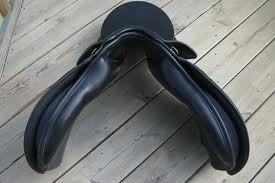
Wither gussets are an additional tear shaped flocked panel toward the top of the panel, their main use, to fill in the small dips to the sides of the wither on horses that have moderate to large withers with hollows on either side. You might be thinking that this sounds familiar to the trapezius panel mentioned above, and in fact it is! Almost always, these two are used in conjunction. A saddle with wither gussets is pictured below right. Full front gussets are an extra full length panel addition with flocking all the way down the length of the front of the panel. These can be useful in several fitting situations. Full front gussets can provide lift to the front of the saddle. They can be used to get more clearance over a horse with a large wither and/or curved back from front to rear to lift the front of the saddle up rather than allowing it to slide forward and down, into the back of the wither. Additionally, they can be helpful with a horse that is pear shaped where the saddle may want to slide forward onto the shoulder.
Below left is a picture of a saddle with full front gussets. Below right is a saddle with wither gussets.

Having an understanding of your horse’s conformation and the available options is crucial to finding the best fitting saddle. Using a saddle that has “options,” but not those that were meant for your horse’s body-type can be worse than using a “standard” saddle and can cause physical and behavioral problems. Compare it to a pair of shoes with a substantial arch that doesn’t correspond with the arch in your foot! Conversely, using a saddle that has just the right “options” for your horse can make all the difference in fit and comfort, resulting in a healthy and happy horse. Hopefully this article clearly defines all of the different options available for panel construction, and how to choose which one would be right for your horse. However, if you have any further questions or comments, don’t ever hesitate to call the shop! We are always here to help you learn all the information and choose what saddle is best for you and your horse!
4 Responses to “Identifying and Understanding Saddle Panel Options”
Sandra Scott
Hi, I live in the U.K. And I found your article very informative. I have one question. My pony has muscle atrophy either side of his withers. Do I still need a saddle with drop panels. Or do I get standard panels to allow the muscle to develop and grow back. Your advice would be very much appreciated. Thank you.
Jay McGarry
You could try shimming the saddle with a correction pad but the most important thing is to make sure the saddle is wide enough for the pony’s shoulders and then have enough shims, flocking or panel depth to get clearance. If you size too narrow just to clear the wither, the shoulders will be pinched.
Laura Henderson
Thank you so much for your clearly written educational articles.
stephanie
Thanks so much, very helpful discussion!