How many of you have heard, “Bring your legs back underneath you – now relax!!!”? You try and try, but all you feel is muscular tension and it just seems like an impossible task. Well, perhaps there is a reason. Is it us, the saddle, a lack of skill or fitness, or just biomechanical issues?
Effective riding involves many aspects. Not only does the saddle have to fit the horse, but it also has to fit the rider. If the rider is to have a positive relationship with the horse, he or she needs to be in a state of balance with neither strain nor tension. In order to achieve stability and softness, the rider needs to feel that their legs fall directly underneath the body. Picture this: imagine there is a string on the top of your head and someone pulled you up straight with the string, let you dangle and then gently lowered you onto the ground into an athletic position. Your body would be skeletally aligned. Now, transfer that to your horse. If you are fighting to stay over your feet because you are tipped backward or forward, then we need to consider ways to help your balance and posture.
The obvious place to start would be with the saddle. The balance of the saddle on the horse is important. I’m sure that most of you have discovered that saddles can feel a lot different on your horse than the way they felt on the perfectly balanced saddle buck in the tack shop! The most common fitting issue is that horses that are uphill or downhill and that factor alone will change your entire relationship with the seat of the saddle.
However, how many of you have thought about the biomechanical aspects of saddle fit in relation to effective riding? In my twenty years teaching skiing and training instructors, I believed that although the mechanics of proper skiing are fairly well spelled out, as they are in riding, the key to effectiveness is greatly influenced by how we are built. Therefore, not everyone can achieve the same success without that consideration.
For example; woman have a different center of mass than men. It is lower and further back. Men, while learning, are more apt to try to “muscle” the horse, using their higher center of mass and greater muscular strength, while women will be more likely to be struggling to get their feet underneath them and leaning forward to compensate.
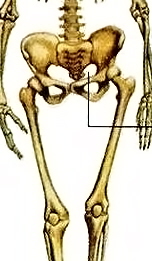
female pelvis and “Q” angle
Susan Harris is one of the gurus of “Centered Riding” and the author of some excellent books and videos including the “Visible Rider”. Susan describes how the shape of the pelvis and how the legs fall from the pelvis impacts the way that the rider sits in the saddle. Women tend to have a wider pelvis which makes it easier for the female to sit on the forward part of the seat bones and to tip forward and hollow their backs. Harris observes that the male pelvis is taller and narrower and the tailbone and sacrum are smaller and shorter, which makes men more prone to “sit on their hip pockets”. Women’s femurs usually hang at an angle inward towards the knee, while a man’s femurs tend to hang straighter. That factor can certainly influence how the “twist” in the saddle may feel to you and how hard or easy it is for you to “wrap” your legs around the horse.

male pelvis
Ideally speaking, your seat bones should find a flat, secure and comfortable place in the deepest part of the saddle. The width and placement of your seat bones determine the comfort of the seat of the saddle; some riders need a narrow seat, some prefer a wider seat. The twist or waist of the saddle is slightly in front of your pubic bones. Many riders feel that they must have a narrow twist, but again, that depends entirely on your pelvic structure. The angle and rise of the twist are also very significant in affecting the comfort of this very sensitive area! Stirrup bar placement is another huge factor in determining your balance point. Many dressage saddles have a more setback stirrup bar. The real key is to make sure that the bar is in the correct relationship to the deepest part of the seat of the saddle, as well as taking into consideration the length of the rider’s thigh. If the bar is too far back for your conformation, you will feel like you are on a diving board!
Remember, we are not created equal and not all teaching/learning strategies are going to be effective. We may have to consider how to solve the above issues with solutions such as, different stirrup bar placement, a correction pad, and a saddle with a narrower or wider twist, the depth of the saddle and the rise of the pommel.