This month I’m touching on horse mythology. I’ve been busy this winter ski racing and ski coaching as well, but now that the skiing is nearing completion, I will be able to get back on Hammie and regale you once again with our exploits! But, for now, read on!
Legend and myth has told us that horses have been associated with water from the beginning of time. The ancient Greeks, the Scottish and Celts have many water and horse associations.
The ancient Greeks believed that Poseidon, (the god of the sea), created the horse. He also created the Hippocampi. The Hippocampus was a creature with the upper body of a horse and the lower body of a dolphin. They are otherwise represented as having the lower body of a sea monster. In Greek mythology Poseidon’s chariot was hauled by a team of Hippocampi. Other gods of the aquatic territory are commonly shown being carried on the backs of similar animals.

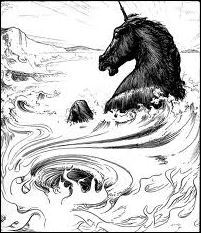
The Scottish thought the horse was roguish leading to the kelpie. The kelpie is a water-spirit that often appears in the form of a horse or a man. It could be found near rivers and other flowing waters in Scotland, but was also said to surface from the sea or from a lake. It was described as only mischievous but sometimes also as a heartless beast that preyed on humans for food. In Scottish culture, hearing a kelpie neigh or bellow during a storm can be an omen of death or destruction, and it could have had only one eye.

The Celts had the Aughisky. The Aughisky took the facade of a gorgeous trustworthy mount and presented itself to be ridden. However, when someone attempted to mount the horse, it would run off and carry its rider to the bottom of a lake of where it would supposedly live and devour its victim. It was believed that if someone successfully subdued the Aughisky by mounting it, they would have a muscular and dependable horse so long as the horse did not see water.